
Mosquitoes kill more people than any other animal on the planet, spreading diseases like dengue, West Nile virus, yellow fever, Zika, and chikungunya. Not only can mosquitoes carry diseases that afflict humans, they also transmit several diseases and parasites that dogs, horses and other livestock are susceptible to. These include dog heartworm, eastern equine encephalitis and West Nile virus.
There are about 200 different species of mosquitoes in the United States, which live in specific habitats, exhibit unique behaviors and bite different types of animals.
Fun Fact: different species of mosquitoes feed on different types of animals. Some feed on birds, some on snakes and frogs and some on mammals.
The Centers for Disease Control and the U.S. Environmental Protection Agency have provided information and resources on mosquito control activities throughout the United States to control and monitor diseases transmitted by mosquitoes. Both biological information about the life and reproduction of the mosquito and epidemiological information about diseases are considered.
Coos County has conducted a mosquito trapping program to identify and monitor the species of mosquitoes occurring here. Mosquitoes were trapped at sites close to standing water throughout Coquille Valley.
Fun Fact: mosquitoes use their piercing mouthparts called a proboscis to penetrate their victims’ skin and feed on blood. The blood provides protein for egg development. Male mosquitoes feed on nectar.
In 2019 residents in and around Coquille noticed a large increase in the number of mosquitoes and brought their concerns about mosquito transmitted viruses and impacts to outdoor activities to Coos County Commissioners. Coos Health and Wellness implemented a survey of Coquille Valley residents to determine the extent and magnitude of the mosquito outbreak. Based on feedback from this survey, Coos County received a private foundation grant to monitor the types and numbers of mosquitoes in the greater Coquille Valley area.
The results of monitoring efforts through 2025 are summarized below:
Fun Fact: mosquitoes can ‘smell’ the carbon dioxide you exhale from 60 to 70 feet away.
Fun Fact: female mosquitoes usually lay up to 200 eggs at a time in or near standing water.
To date, no outbreaks of mosquito transmitted diseases have been reported in Coos County. Additionally, there is no record of Coos County engaging in mosquito control except in 2013 and 2014 when the US Fish and Wildlife Service contracted with the County to treat areas in Bandon Marsh. Several Oregon counties have active mosquito control programs to prevent and monitor mosquito transmitted diseases including West Nile virus. The closest to Coos County include Jackson and Lane Counties.
During favorable years, large numbers of mosquitoes may be noticeable to residents of the Coquille Valley. In summer, most species of mosquitoes need about one week to develop from egg to biting adult. If you allow standing water near your house, on your property, or on your farmland, even in small amounts, you are inviting mosquitoes to multiply. You, your neighbors, and the community can take steps to significantly reduce mosquitoes in and around homes, in your neighborhood and on flood irrigated agricultural lands throughout the Coquille Valley. Be a considerate neighbor and remove or treat sources of standing water where mosquitoes may reproduce.
Mosquito Control
Successful mosquito control strategies include several tactics to eliminate mosquitoes and their habitat. The best approach to controlling mosquitoes uses a unified approach called integrated pest management or IPM. This approach takes advantage of every life stage of a mosquito.
Removing Mosquito Habitats
Mosquitoes need water for both the larval and pupal development. An important part of mosquito control around your home is to eliminate and monitor standing water sources.
- Remove standing water in rain gutters, old tires, buckets, plastic covers, toys or any other container where mosquitoes can breed.
- Empty and change the water in bird baths, fountains, wading pools, rain barrels and potted plant trays at least once a week.
- Drain temporary pools of water or fill with dirt.
- Keep swimming pool water treated and circulating.
Using Structural Barriers
Structural barriers are an important way to reduce the incidence of mosquito bites in your home.
- Install window and door screens if they are not already in place.
- Make sure windows and screens are “bug tight”. Replace or repair screens if they have holes.
- Cover gaps in walls, doors and windows to prevent mosquitoes from entering.
- To protect young children, cover baby carriers and beds with netting.
Using Mosquito Deterrents or Preventing Mosquito Exposure
Use various tactics to avoid mosquito bites.
- Keep mosquitoes away from exposed skin by wearing long-sleeved shirts, long pants, and socks. Use head nets in areas with high mosquito populations.
- Tuck shirts into pants and pants into socks to cover gaps in your clothing where mosquitoes can get to your skin.
- Stay indoors during times of the day when mosquitoes are most active.
- Use topical mosquito repellents when necessary and follow label directions and precautions closely.
- Replace your outdoor lights with yellow “bug” lights, which tend to attract fewer mosquitoes than ordinary lights.
- Try spatial repellent methods (methods that cover an entire area) that emit active ingredients into the air. Examples include candles containing citronella or other mosquito-deterrent essential oils or portable, battery-operated spatial mosquito deterrents.
- EPA website: Controlling Mosquitoes at the Larval Stage
Fun Fact: In optimal conditions a female mosquito can lay up to 200 eggs which develop into adult mosquitoes in less than a week. In one week, one female mosquito can produce 200 more mosquitoes. Within two weeks’ time that same mosquito can produce 40,000 mosquitoes. In three weeks’ time, 8 million mosquitoes and in four weeks’ time produce 1.6 billion mosquitoes.
Controlling Mosquito Larvae
The most successful control efforts supplement habitat removal with other means of control. Treating and reducing immature stages of mosquitoes (egg, larva, and pupa) are generally the most effective, least costly way to control mosquitoes. There are several options including both biological and chemical larvicides.
- Bacterial Insecticides
- Bacillus bacteria: bacteria such as Bacillus thuringiensis israelensis (Bti) or Bacillus sphaericus (Bs) kill mosquito larvae in standing water. These bacteria only affect insects by producing toxins that destroy the larvae’s gut after being ingestedresulting in starvation. Bti and Bs are considered safe for humans, pets, livestock and wildlife. Common forms include briquettes, dunks, and granules that are placed in water sources like rain barrels or ponds to prevent adult mosquitoes from emerging. Coos County has free Bti dunks available to anyone interested in using them.
- Wolbachia bacteria: another insect-specific bacterium call Wolbachia naturally occurs in many insects including mosquitoes. Wolbachia blocks the ability of viruses to grow in adult mosquitoes, thus by infecting an entire population of mosquitoes with Wolbachia the risk of virus transmission to humans is mostly eliminated. Additionally, male mosquitoes can be lab-raised and infected with a particular strain of Wolbachia, then released into the wild. After an infected male mosquito mates with a wild female the resulting eggs will not hatch. Like Bacillus bacteria, Wolbachia bacteria are not known to harm humans or other animals.
- Mosquito fish (Gambusia affinis): these small fish are an environmentally friendly alternative to chemical pesticides. They have a voracious appetite consuming hundreds of mosquito larvae and pupae daily and can thrive in a wide range of conditions. They are best suited for water sources that do not connect to natural waterways, like ornamental ponds, livestock troughs, or unused swimming pools. Introducing mosquitofish to natural waterways can negatively impact native fish and wildlife by competing for food and habitat.
- Insect Growth Regulators: these types of larvicides prevent mosquitoes from completing their life cycle and becoming adults. By acting like insect hormones, these chemicals interfere with insect growth and development. They can prevent normal molting, egg-laying, egg-hatching, and development from immature mosquito phases (larva and pupa) to adult phases. Options include Methoprene and pyriproxyfen.
- Larvicidal Oils and Films: when applied to standing water, oils and films disperse in a thin layer over the surface of the water. Larvicidal oils and films are generally used for controlling mosquito pupae. Mosquito pupae live in water but do not feed which makes other treatments ineffective. The film reduces the surface tension of the water which makes it difficult for mosquito larvae and pupae to attach to the surface and breathe, resulting in their drowning. The oil film also acts as a physical barrier for adult mosquitoes making it difficult or impossible for them to land on the water to lay eggs.
Controlling Adult Mosquitoes
Chemical pesticides are used to reduce adult mosquito populations and are known as adulticides. These are typically applied either using aerial spraying by aircraft or on the ground by truck-mounted sprayers.
- Adulticides: application methods are ultra-low volume sprays or fogs which target flying adult mosquitoes. A very small quantity of insecticide is atomized into small droplets and broadcast in a fog aimed where adult mosquitoes are active. Adulticides are used for public health mosquito control programs or when communities seek to control an outbreak of mosquito-borne disease or a very heavy, nuisance infestation of mosquitoes. Typical adulticides include pyrethrins and organophosphates.
- EPA website: Pesticides Used To Control Adult Mosquitoes
Fun Fact: mosquitoes leave behind an itchy welt after biting which is our body’s reaction to an anti-coagulant and mosquito saliva injected into our skin by the mosquito. Only females actually bite.
Mosquito Life Cycle
The mosquito life cycle typically takes up two weeks, but depending on conditions, it can range from 4 days to as long as a month. Mosquitoes have four life stages: egg, larva, pupa, adult.
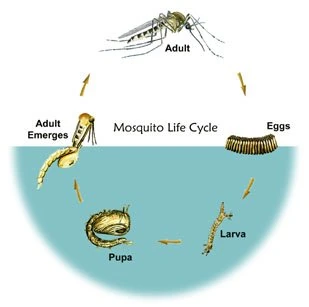
- Many mosquitoes lay their eggs on the surface of fresh or stagnant water. The water may be in tin cans, barrels, troughs, ponds, puddles, creeks, ditches, or marshy areas. Tiny mosquito larvae emerge from the eggs within 24 – 48 hours.
- Mosquito larvae, commonly called “wigglers,” live in water from 4 to 14 days depending on water temperature. Larvae come to the surface to obtain oxygen through a breathing tube called a siphon which breaks the water surface tension. Larvae hang with their heads down using brushes by their mouths to filter feed on algae, plankton, fungi, bacteria and other microorganisms. When a larva molts for the fourth time, it becomes a pupa.
- Mosquito pupae, commonly called “tumblers,” live in water from 1 to 4 days, depending upon species and temperature. The pupa floats at the surface of water. It takes oxygen through two breathing tubes called “trumpets”. When disturbed, it dives down in a jerking, tumbling motion then floats back to the surface.
- The metamorphosis of the mosquito into an adult is completed within the pupal case. The adult mosquito splits the pupal case and emerges out of the water where it rests until its body dries and hardens. Then it flies away, ready to begin its lifecycle.
Learn More
For more information on mosquito control methods visit:
Fun Fact: mosquitoes wings beat 300 to 600 times per second and create the buzzing sound you hear. Females have a higher pitched buzz which helps them attract males. Male mosquitoes find female mosquitoes by the pitch of their buzzing sound.